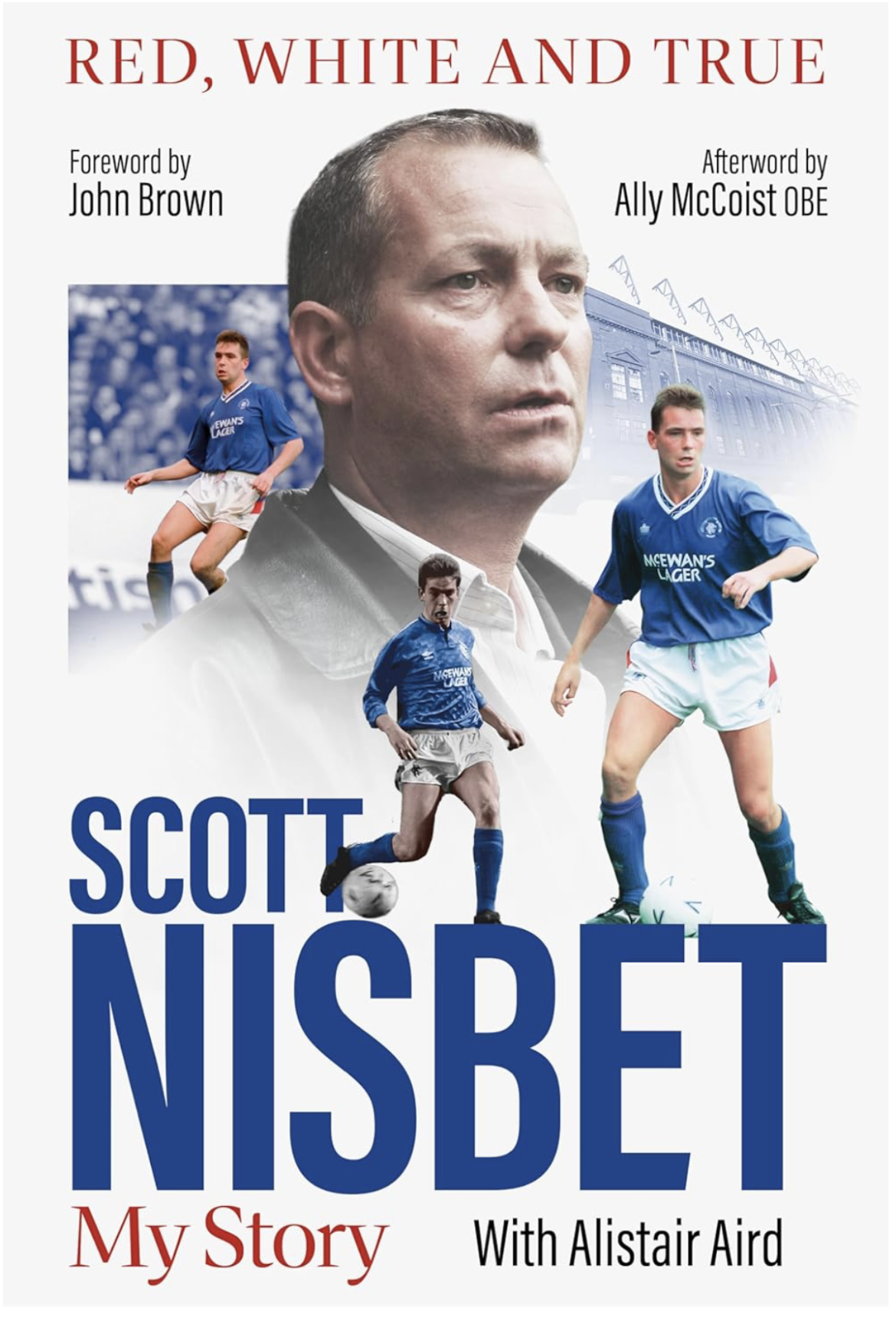
Review by David Herd
There are broadly speaking two types of footballer autobiography. There are those written by the top players, those who made a huge name for themselves in the game or at a specific club. Recently we’ve seen books released telling the stories of Duncan Ferguson and Paul Gascoigne, as examples. Then there are the ones covering the life and times of what are often described as “cult heroes”, players who maybe didn’t reach the top in terms of achievements or ability, but who hold a place in the hearts of fans for their personality or attitude. Last year, one such player in Marvin Andrews brought out his story. This October, former Rangers player Scott Nisbet, alongside experienced biographer Alistair Aird, released this publication to tell of his life on and off the football pitch. After completing Red, White and True, I can confirm that he has a story worth reading.
As someone who saw Scott’s entire Rangers career, from his early teenage matches as a centre forward, to seeing him play a role in defence for several title-winning teams, I already had my own memories of him as a player. When he wore the royal blue shirt, he was a fully-committed, passionate and loyal Ranger, who had limitations in terms of ability perhaps, but who always gave the team his every effort. After reading this fascinating story of his life in and out of football, I now know that description fits him as a man as well as a footballer.
Most Read on FollowFollow.com Quotes from the Brann and Rangers press conferences Sturm Graz Quotes Match Report – Strum Graz 2-0 Rangers
But I’ll start with his career on the pitch. Scott played under some legendary managers, and it seems fair to say that his relationship with them varied. The motivation and encouragement of Jock Wallace is mentioned several times, with Jock the manager who gave Scott his first team chance after excellent form in a reserve team that contained its fair share of star names. These days, can you imagine hearing about a second team with youngsters like Ian Durrant, Robert Fleck and Derek Ferguson all in it? It was under Jock that the teenage Nisbet discovered the thrill of playing in front of the Ibrox crowd, and also the perils of sharing a dressing room with the likes of McCoist and Cooper!
Wallace was replaced by Graeme Souness in 1986, and at the time Scott was a regular for the Scotland youth teams and doing well with them. It’s fair to say that he looks back on his time under The Magnificent One with as many negatives as positives. He credits Souness for the decision to convert him into a defender that allowed him to play in so many games for Rangers, as it became obvious he wasn’t going to dislodge the star strikers Souness had assembled. But he did play a couple of memorable games up front in an injury crisis, and scored in a Hampden semi-final against Hearts, with the goal and the unique celebration dance, remembered affectionately.
But the Souness – Nisbet personal relationship has a number of references, and most of them clearly show that they simply did not get on. The story of Souness wanting to sell Nisbet to fund an incoming transfer, and Scott’s absolute refusal to leave the club he loved, doesn’t give a flattering impression of the Souness man management skills. Scott is fair to point out that this was an inexperienced young manager in his first job, but the fact that he also relates a tale of the two of them almost coming to blows tells us that he doesn’t see that as a justification for the way he was treated.
But Scott would outlast the manager, and remained at the club, albeit as a fringe player, until Souness had left for Liverpool. He then played under Walter Smith, whose interpersonal skills are described very differently. Like just about every player who was ever in the Ibrox dressing room during the Walter Years, Scott Nisbet cannot praise Smith highly enough. He enjoyed some amazing times under Walter, with the most memorable of all that crazy goal against FC Brugge in a memorable season that saw a treble as well as coming so close to Champions League glory. That goal gets talked through, of course, but it’s a bittersweet memory given it was the last game Scott ever completed. The following weekend he picked up the injury that ended his career.
And that injury, as well as several other tough times personally, are really the bedrock of his story. Like all good biographies, there is much to tell, much to learn, and much to admire, in finding out about life away from the public glare of the football pitch. And it starts from a young age, Scott telling of a difficult upbringing in a broken household, and in an area of Edinburgh where gangs, drink, drugs and violence were all too common. His football ability, and his dedication to a career in the game, undoubtedly prevented him from falling into some or all of these other dangerous activities. He admits freely that school was never going to be about academic achievement, and if not for football, his school life could easily have ended in disgrace.
And bouncing back from bad times is the real theme of this book. Career wise, Scott won league titles and played in the biggest matches after being told he had no future at Ibrox. But he has endured far worse than that in his personal life. We read about the tragic death of his sister, made all the more heartbreaking and difficult to accept by the part played in it by medical negligence. We read about his terrible luck with injuries, which culminated in the one that ended his career and that could have crippled him for life had he refused to accept the seriousness. We read about his marriage breakup, and the impact on both him and his children. We find out about how he was betrayed by a close friend, and nearly lost everything he had as a business venture fell into the wrong hands. And, of course, we read about the biggest battle of all, his cancer diagnosis and the exhausting treatment he had to endure and the stress of how successful that treatment would be.
Any one of these terrible events would have flattened a lesser man, and most of us would not have the spirit nor the resilience to get through them all. But Scott’s amazing positivity, and his determination to see it through to spend more time with his children, won though, and shone through. In essence, this is more the tale of how one man’s courage and determination kept beating the odds, rather than the story of a footballer. Some of those setbacks were in football, and it was football that gave Scott his fame and his fortune. But, entertaining and informative as the football memories were, the real strength of this book is the character of the man himself.
And this determined, resilient and popular footballer certainly has made many friends along the way. It’s a real tribute to him when you read the number of former colleagues who volunteered to pay tribute to him in the book. Richard Gough, John Brown, Ian Durrant, Terry Butcher and Sir David Murray all provide warm words and genuine affection in a section of the book that reads like a Hall of Fame gathering. And, of course, there is a last tribute from the man Scott jokingly described as “the busiest man on the planet”, a certain Ally McCoist, who was on the pitch with Scott when he made both his first and last Rangers appearance. Many of these legendary names were recipients of a testimonial from Rangers, and one of the really pleasing aspects to the sad story of Scott’s career-ending injury was how the club wanted to give him a benefit match too, and how truly appreciated that was by the man himself.
The book has plenty humour, as you would expect when there are stories from that famous Rangers dressing room. That lends a nice balance to the all-too-frequent moments of hardship and worry that have been such frequent visitors into Scott Nisbet’s life. It also frequently uses the language of the dressing room, the “F” word makes plenty appearances throughout, and although that simply reflects the reality of football (and every day) language, it probably is right to point it out so that it doesn’t come as a surprise.
After reading this book, I’m so glad that it didn’t become a stats exercise of goals and games, although it does end with a complete list of Scott’s Rangers career games and goals, as well as all his Scotland representative statistics. This is a book made infinitely more powerful and more readable by containing so many stories and personal memories away from football. Rangers, and the players, managers and supporters who were so much part of Scott’s life, run right through the book. His absolute pride in his Ibrox career, and his love of the club itself, definitely shine through. But it is the most famous word associated with the manager who gave Scott his breakthrough in football that best describes Red, White and True. The great Jock Wallace spoke of the importance of “character”. If the man himself had still been here to read this story of one of his players, Jock himself would be proud of the character Scott Nisbet has shown. And that’s why I’d recommend this book as one well worth reading.
SALES LINK – https://www.amazon.co.uk/Red-White-True-Scott-Nisbet/dp/1836801874/ref=mp_s_a_1_1?crid=3QJLQ2H3PNRWS&dib=eyJ2IjoiMSJ9.gz4L2Fl0DDaubTTe36wFw4DpDn87HMbPeoKW9yN6fxs.jgsrBbl2ZdQRi2HZl0XBYT4BMibdCjkQcn56luMYvrI&dib_tag=se&keywords=scott+nisbet.+red+white+and+true&qid=1761585858&sprefix=scott+nisbet%2Caps%2C146&sr=8-1